The government of Guinea-Bissau has issued a strict warning, banning public demonstrations or rallies in the country.
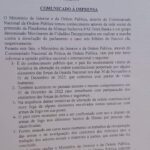
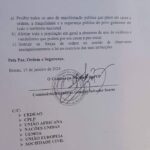
The Ministry of the Interior and Public Order, which issued the order on January 15, 2024, explained that the measure is due to ongoing operations involving the search and seizure of firearms. The weapons in question were allegedly taken from a barracks during incidents related to alleged coup attempts on February 1, 2022, as well as on November 30 and December 1, 2023.
Commissioner Salvador Soares, national commissioner of the Public Order Police (POP), made the announcement in response to “information circulating on social networks” about possible public demonstrations.
The announcement came about a week after President Umaro Sissoco Embaló’s speech on January 6, 2024, in which he affirmed his commitment to restoring order in Guinea-Bissau.
For a country plagued by cartel violence and serial coups d’état, including two failed attempts in the last year, it seems that by default, the ex-military man will become stricter with national security measures and strengthen democratic institutions.
But the next sentence would surprise any defender of freedom of expression and freedom of assembly.
“There will be no more ‘pagaille’ (disorder), and any demonstrations will be responded to appropriately,” said the President in his speech, explicitly comparing demonstrations to disorder. With this decision, Guinea-Bissau has joined neighboring Guinea in officially banning public parades. And like its French-speaking neighbor ruled by a military junta, the Lusophone country has recently been a difficult environment for media practice.
The political situation in the country is affecting civic space, following a raid on police cells by some National Guard officers to free Finance Minister Suleimane Seidi and Treasury Secretary António Monteiro on November 30, 2023. The attempt to free the two, who had been detained on allegations of corruption, led to two days of sporadic shootings, including skirmishes near the presidential palace, in an attempt to subvert the government. At least two people died in the process, according to reports, and the president dissolved parliament.
The national broadcaster soon became the center of a power struggle. Days after the dissolution of Parliament, on December 4, 2023, armed men went to the national radio and television stations and ordered all workers to leave the premises, after which they shut down broadcasts for almost the entire day. Subsequently, the Director of the National Radio Service, Baio Danso, was summarily dismissed and replaced by Mama Saliu Sane, the former director who was removed after the opposition won the legislative elections in June 2023.
The ban on demonstrations unduly restricts civic space and violates Article 54 (1-2) of Guinea-Bissau’s 1984 Constitution, which guarantees the right to freedom of assembly.
Guinea-Bissau’s Media Actors (SINJOTECS, OJGB, AMPROCS and RENARC) and the Media Foundation for West Africa (MFWA) call on the government to reconsider the ban on demonstrations and take measures to protect civic space. Recognizing the delicate security and political situation in the country, this should not be used to deny basic rights. We urge political and social actors in Guinea-Bissau to engage in dialogue and call on the authorities to allow citizens to contribute to public discourse.
Press Release – Ministry of the Interior and Public Order