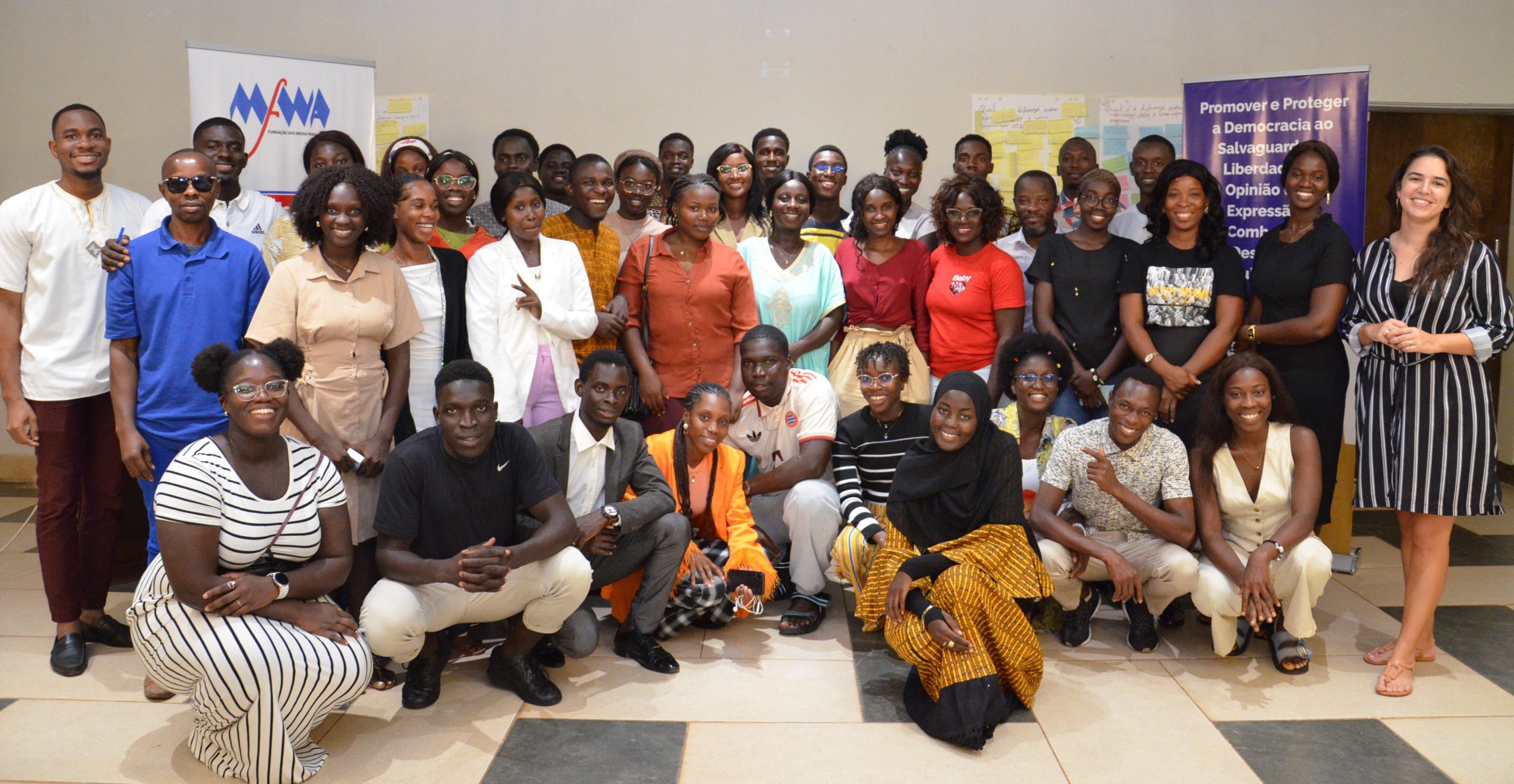
From July 29 to August 1, 2025, the Media Foundation for West Africa (MFWA) held two series of two-day training workshops for young people from all regions of Guinea-Bissau. The workshops are part of our project “Promoting and Protecting Democracy by Safeguarding Freedom of Opinion and Expression and Combating Mis/Disinformation in Guinea-Bissau”. This project is funded by the European Union (EU) and implemented in partnership with Reporters Without Borders (RSF) and the Hirondelle Foundation (FH).
The workshops respond to the increasing spread of harmful narratives on both traditional and digital platforms. Young people, as the most active demographic group on digital platforms, are particularly vulnerable to these harmful narratives. However, they also have enormous potential to act as agents of positive change in their communities.
During the opening ceremony on July 29, 2025, the Minister of Culture, Youth and Sport, Maria da Conceição Évora, warned against the misuse of social networks as tools for manipulation and incitement to violence, and called on young people to be critical, aware and proactive.
“We live in a time when social networks – which should be a space for healthy debate and strengthening citizenship – have unfortunately been used to spread disinformation, insults and personal attacks, often with the aim of destabilizing institutions and weakening social cohesion. Young people must be protagonists, not spectators. This transformation begins within each one of you,” she said.
The Minister of Culture also highlighted the importance of the workshops and reaffirmed the government’s strong commitment to promoting these initiatives, which empower young people to identify and combat disinformation and hate speech.
The European Union Attaché for Cooperation on Justice, Security, Gender and Human Rights, Carlos Abaitua Zarza, expressed the EU’s commitment to promoting human rights, including freedom of expression. He stressed that freedom of expression is the foundation of active and conscious citizenship, but it must be exercised responsibly.
“Freedom of expression is not about spreading lies or offenses – it’s about defending the truth, promoting respect and building bridges between people and communities,” Zarza said.
Delali J-D Dessouassi, Program Associate for Freedom of Expression and Digital Rights at the MFWA, encouraged young people to take advantage of the training as an opportunity to strengthen their skills and position themselves as agents of change.
“With the right tools, training and support, young people can become defenders of the truth, promoters of respectful discourse and champions of a more informed, resilient and united society in diversity,” he said.
The representative of the CNJ, Damião Mendes, put into context the risks posed by disinformation in a country undergoing political and institutional transition. He stressed the need for a politically enlightened and active youth, capable of distinguishing between freedom of expression and ideological manipulation.
RENAJ representative Hipólito Vaz highlighted the role of young people in building healthy social coexistence, reaffirming the youth network’s willingness to collaborate in defending democratic values.
A total of 86 young people were divided into two groups and each benefited from a two-day training workshop. The workshops covered media literacy, disinformation, hate speech, freedom of expression, digital security and ethical content creation.
Real-life examples, such as viral posts, discriminatory phrases and videos circulating in Bissau, were combined with interactive group exercises, including identifying and transforming hate speech into constructive criticism. These dynamics generated enriching discussions, helping participants to understand the difference between freedom of expression and harmful speech, as well as the responsibility that comes with sharing information.
The workshops brought together youth leaders, students, activists, digital content creators and people with disabilities. One of the main outcomes of the training was the development of a practical toolkit that provides young people with strategies to critically analyze media content, promote responsible information sharing, become ambassadors for truth and tolerance, raise awareness among their peers and challenge harmful narratives in their circles.