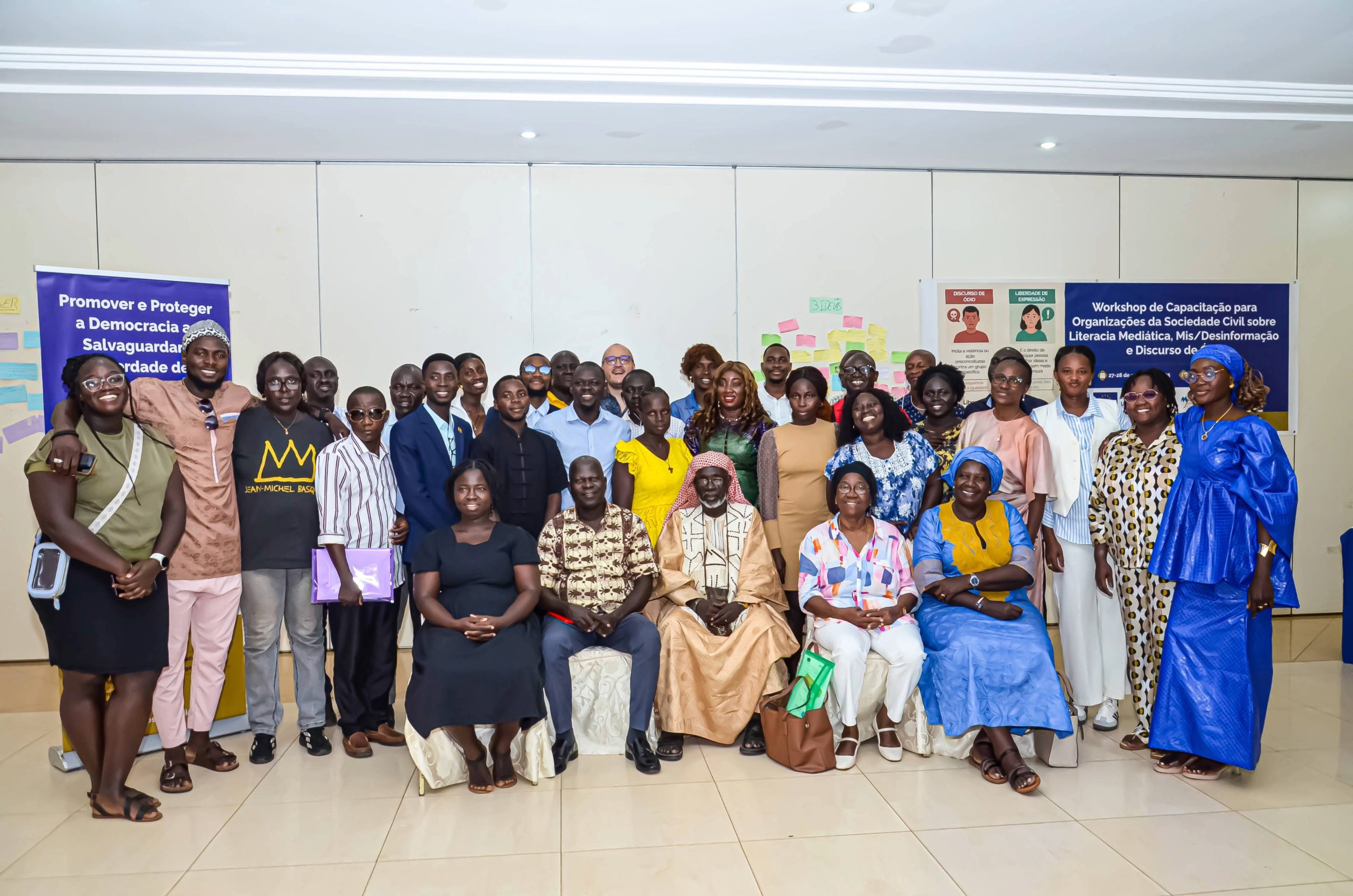
From October 26 to 27, 2025, the Media Foundation for West Africa (MFWA), with the support of the European Union (EU), organized a capacity-building workshop for civil society organizations (CSOs), focusing on media literacy, disinformation and hate speech.
Held at the Hotel Dunia in Bissau, this two-day workshop is part of the EU-funded project entitled “Promoting and Protecting Democracy by Safeguarding Freedom of Opinion and Expression and Combating Mis/Disinformation in Guinea-Bissau”. The project is implemented by the MFWA, in partnership with Reporters Without Borders (RSF) and the Hirondelle Foundation (FH).
The training aimed to strengthen participants’ skills in identifying and combating disinformation and hate speech, promoting truthful information and fostering constructive dialogue in their communities.
The sessions focused on how disinformation spreads on digital platforms and how hate speech can fuel division and undermine democratic dialogue. Through practical exercises and group discussions, participants analyzed viral content online, applied fact-checking techniques and developed strategies to promote responsible communication on their networks.
One of the main outcomes of the training was the development of a practical guide for civil society organizations. This guide provides guidance on media literacy, fact-checking and community-based approaches that can help combat disinformation and hate speech.
Thirty-five representatives of civil society organizations from all regions of Guinea-Bissau took part in the training. These included women’s groups, human rights and religious organizations, peace-building initiatives, media organizations and groups representing people with disabilities. The workshop also served as a platform for peer learning and the sharing of experiences, thus encouraging collaboration and coordinated responses to damaging narratives.
Participants reported greater confidence in identifying misleading information and promoting responsible information sharing in their networks.
Civil society organizations play a crucial role in community engagement and mobilization, advocacy and the promotion of democratic values in Guinea-Bissau. However, due to limited technical skills and weak response mechanisms, many face difficulties in responding effectively to damaging narratives.
By equipping CSO actors with the knowledge and tools needed to identify and combat harmful media content, the initiative contributes to raising public awareness of the risk of disinformation. It also contributes to building a more resilient civil society sector, while supporting efforts to promote an informed public discourse, social cohesion and democratic participation in the country.