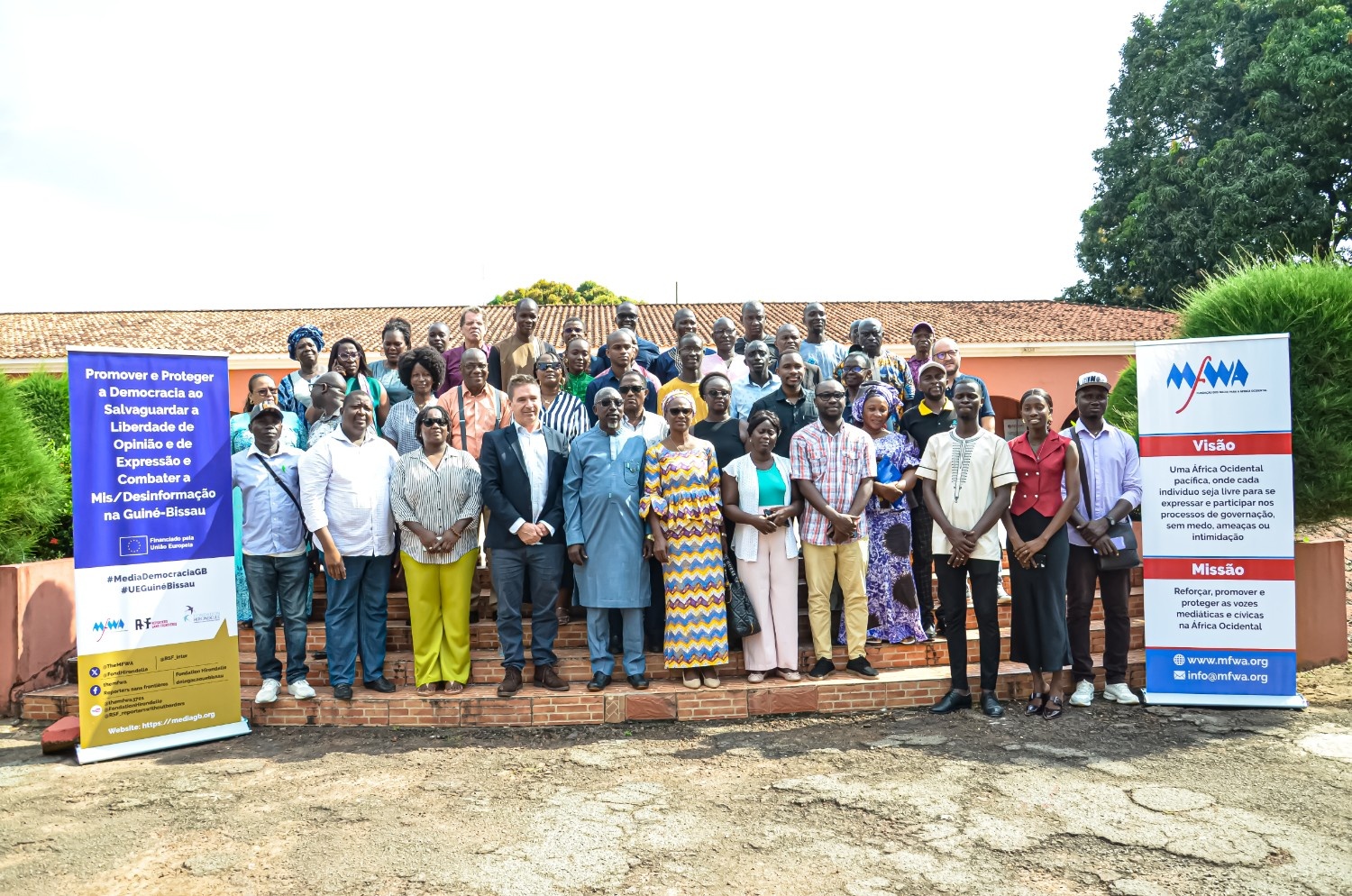
On October 29, 2025, media professionals, academics and representatives of media regulatory bodies met to approve the revised Code of Ethics for Journalists in Guinea-Bissau. The Code of Ethics, the last version of which dates back to 2018, has undergone a thorough review and update to respond to current challenges, including digital disinformation, online harassment and the safety of journalists.
The Code of Ethics was approved during a forum on ethical journalism held at the Hotel Dunia in Bissau. The event was organized by the Media Foundation for West Africa (MFWA), in partnership with Reporters Without Borders (RSF) and Fondation Hirondelle (FH), as part of the European Union-funded project entitled “Promoting and Protecting Democracy by Safeguarding Freedom of Opinion and Expression and Combating Mis/Disinformation in Guinea-Bissau”.
The forum began with speeches from the main institutional players, who stressed the importance of ethical journalism in Guinea-Bissau, especially in the context of the country’s changing political and media landscape.
In his remarks, the acting president of Guinea-Bissau’s National Media Council (CNCS), Meta Camara, highlighted the importance of the initiative. He also stressed the responsibility of media professionals to uphold ethical standards.
“Ethical journalism requires a responsible practice of communication, based on sacred principles such as truth, impartiality, social responsibility and respect for human dignity,” concluded Mr. Camara.
Indira Correia Baldé, president of the Union of Journalists and Media Technicians (SINJOTECS), stressed the importance of updating the Code of Ethics to reflect the new realities of the media landscape.
“It made perfect sense for the code to be updated compared to the previous one, since when we validated the 2018 code, we didn’t include issues such as misinformation and disinformation, nor did we highlight digital media. This new code, which we are validating today, includes these components, which will be very important in carrying out our work,” he said.
He also encouraged participants to get actively involved in the validation process, stating that “the document is ours, it’s Guinea-Bissau’s and it’s for Guinea-Bissau’s professionals. It is therefore important that we are all open to discussing and validating this new code.”
Representing the European Union, the Attaché for Cooperation in Justice, Security, Gender and Human Rights, Carlos Abaitua Zarza, stressed the urgency of promoting ethical journalism, especially in a context of spreading disinformation and hate speech.
“We are living through a very difficult time in Guinea-Bissau, marked by the increase in disinformation, the spread of hate speech and the constant threat to media professionals. These phenomena not only compromise the credibility of journalism, but also weaken the foundations of democracy. Journalism that is committed to truth, impartiality and respect for human rights ensures that the population has access to reliable and relevant information,” he said.
Mr. Zarza also said that supporting ethical journalism is essential for building informed and democratic societies.
Delali Jean-Daniel Dessouassi, Program Associate for Freedom of Expression and Digital Rights at the MFWA, highlighted the importance of the initiative at a time when the country is preparing for elections.
“This forum comes at a very important time for the media in Guinea-Bissau, especially as the country prepares for the next elections. In periods like this, the role of the media in providing accurate, balanced and responsible information becomes even more essential,” he said.
As Guinea-Bissau continues to navigate a rapidly evolving news environment, the revised Code of Ethics provides an important framework to guide journalists in upholding the principles of integrity, accountability and public service that underpin democratic societies.
The forum also included a presentation of the results of a monitoring exercise that analyzed ethical standards in selected print, audiovisual and online media. The presentation, which focused on the results of the monitoring for the first quarter (July and September 2025), highlighted recurring challenges affecting journalism in the country. These include issues related to the verification of information, editorial independence and the growing influence of social media in defining public discourse.
Participants engaged in lively debates after the presentation and shared experiences from their professional environments. Several participants stressed the importance of reinforcing fundamental journalistic principles such as accuracy, fact-checking and the right of reply. Other participants also highlighted concerns related to economic pressures within media organizations and the blurring of boundaries between editorial and sponsored content.
The discussions also explored the impact of social networks on the information ecosystem, in particular the growing difficulty in distinguishing professional journalism from unverified or opinion-based content circulating online.