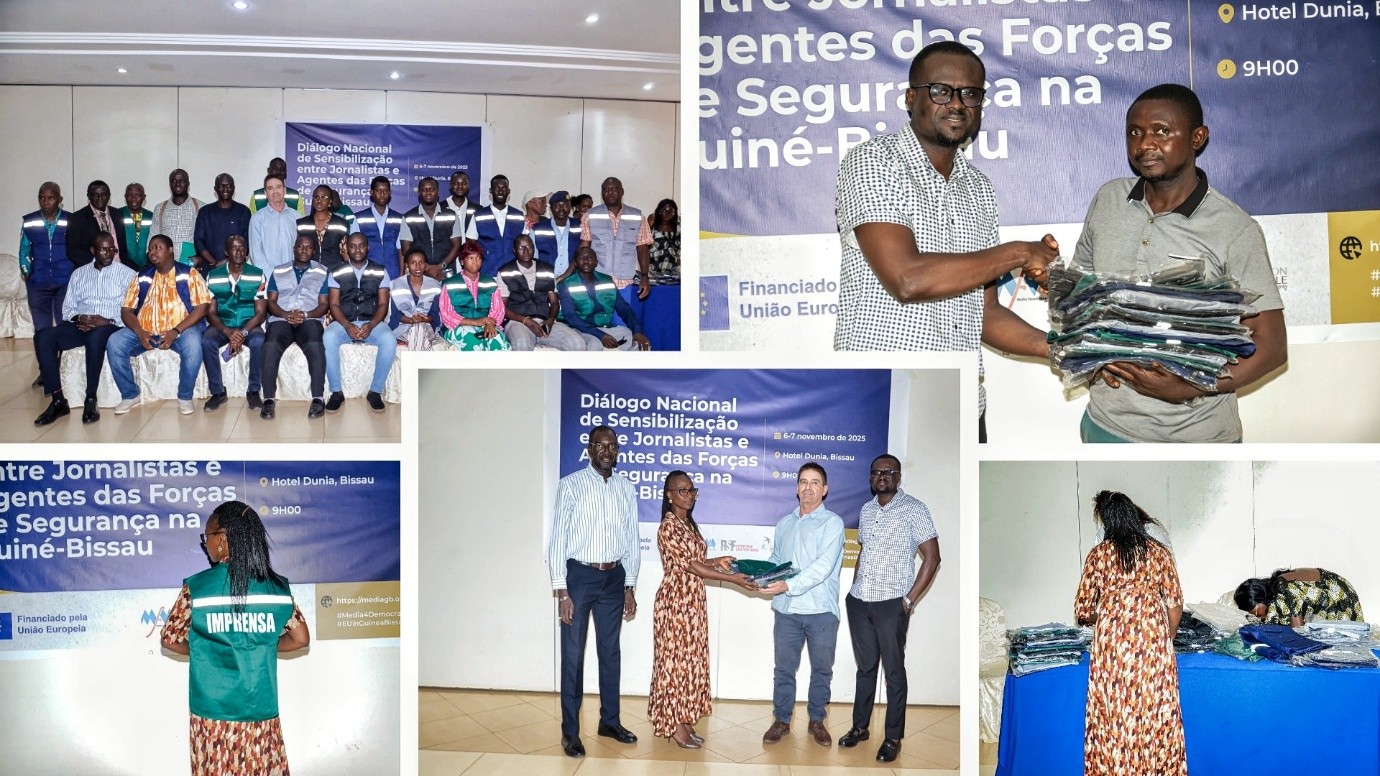
The Media Foundation for West Africa (MFWA), in partnership with Reporters Without Borders (RSF) and the Hirondelle Foundation (FH), donated 300 reflective vests to journalists in Guinea-Bissau, with the aim of enhancing their safety as the country prepares for national elections.
The presentation took place on Friday, November 7, 2025, at the Hotel Dunia in Bissau, as part of the EU-funded project titled “Promoting and Protecting Democracy by Safeguarding Freedom of Opinion and Expression and Combating Misinformation in Guinea-Bissau.”
The distribution of these vests is intended to improve visibility and reduce risks for journalists working in potentially volatile environments, including protests, campaign events, and other high-risk election-related assignments.
“Safety is a fundamental right and a necessary condition for journalists to serve the public,” said Dr. Daniel Kwame Ampofo Adjei, PMP®, Director of Institutional Development and Monitoring, Evaluation, and Learning (MEL) at MFWA, during the handover. “These vests are a practical contribution to the protection of reporters and to supporting the country’s democratic process.”
The donation was part of a broader event held on the same day, which provided a forum for dialogue among journalists, security agencies, and civil society organizations on improving security and collaboration during the election period. Participants discussed the risks faced by the media, the need for clear channels of communication, and ways to ensure accountability when rights violations occur.
SINJOTECS President Indira Correia Baldé welcomed the initiative and described it as a significant step forward in protecting journalists. She expressed optimism that the commitment demonstrated through dialogue and the donation would help strengthen trust between media professionals and security institutions. Ms. Baldé also thanked the organizers, noting that the reflective vests would “significantly increase the safety of journalists working in the field.”
The forum, moderated by Bubacar Turé, president of the Guinean Human Rights League, brought together representatives from key government institutions, including the Ministry of the Interior for Public Order (Public Order Police and Rapid Intervention Police), the Ministry of Defense (National Defense Institute and General Staff of the Armed Forces), the Ministry of Justice (Judicial Police and Public Prosecutor’s Office), and the National Council for Media.
Among the media sector stakeholders in attendance were SINJOTECS (Union of Journalists and Media Technicians), AMPROCS (Association of Professional Women in the Media), the Order of Journalists, and RENARC (National Network of Community Radio and Television Stations).